CEM25P users - DEC backlash problem

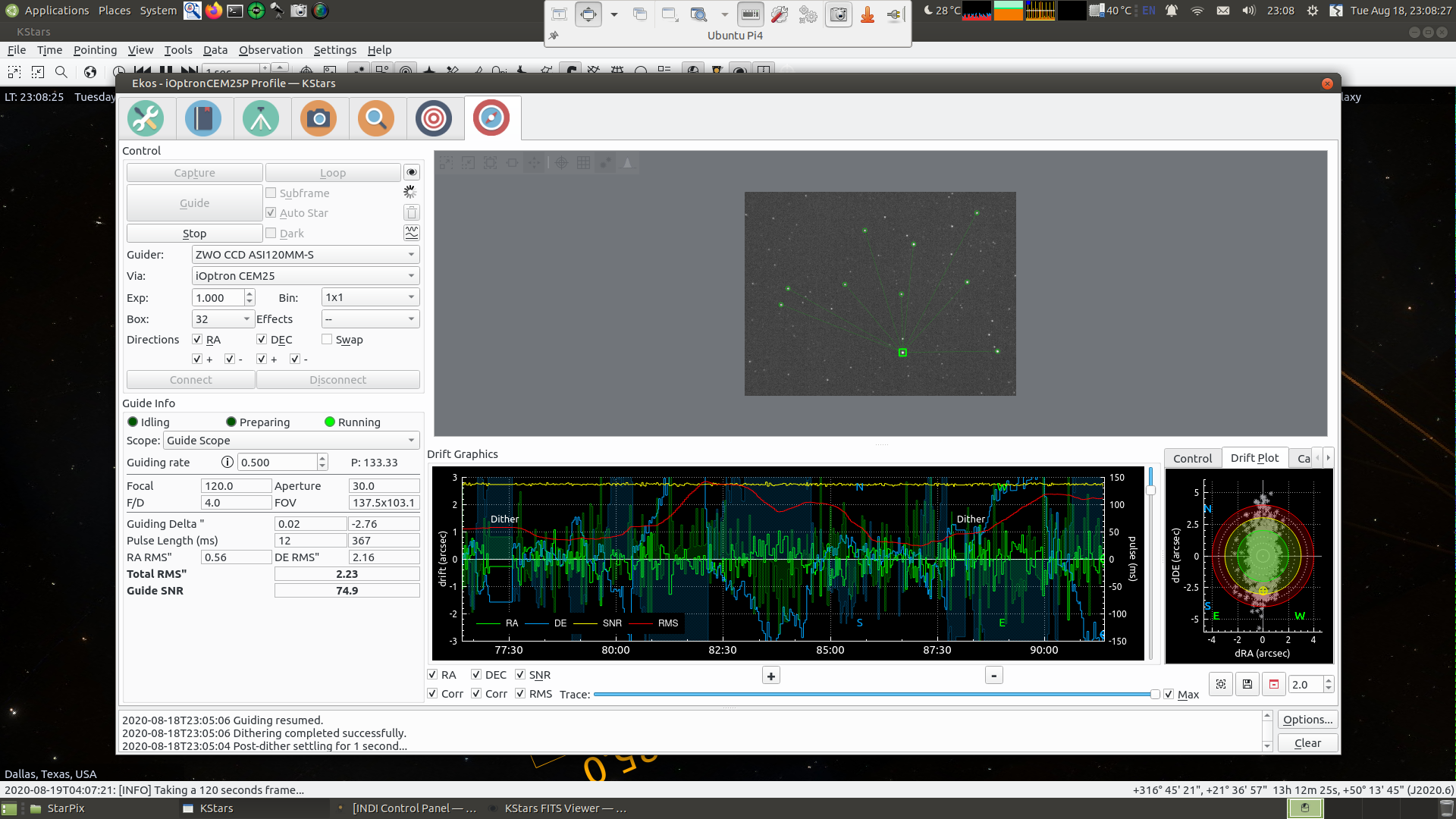
I have a new CEM25P mount and whatever I try, I cannot get rid of the backlash in DEC. It guides phenomenally well in RA, but not so in DEC. I have tightened the belt, there is no discernible play in the gears, I have tried guiding in perfect balance and moderately unbalanced (to preload the gears), nothing makes a difference.

Any suggestions how to improve on this are most welcome!

Jo

Jo,

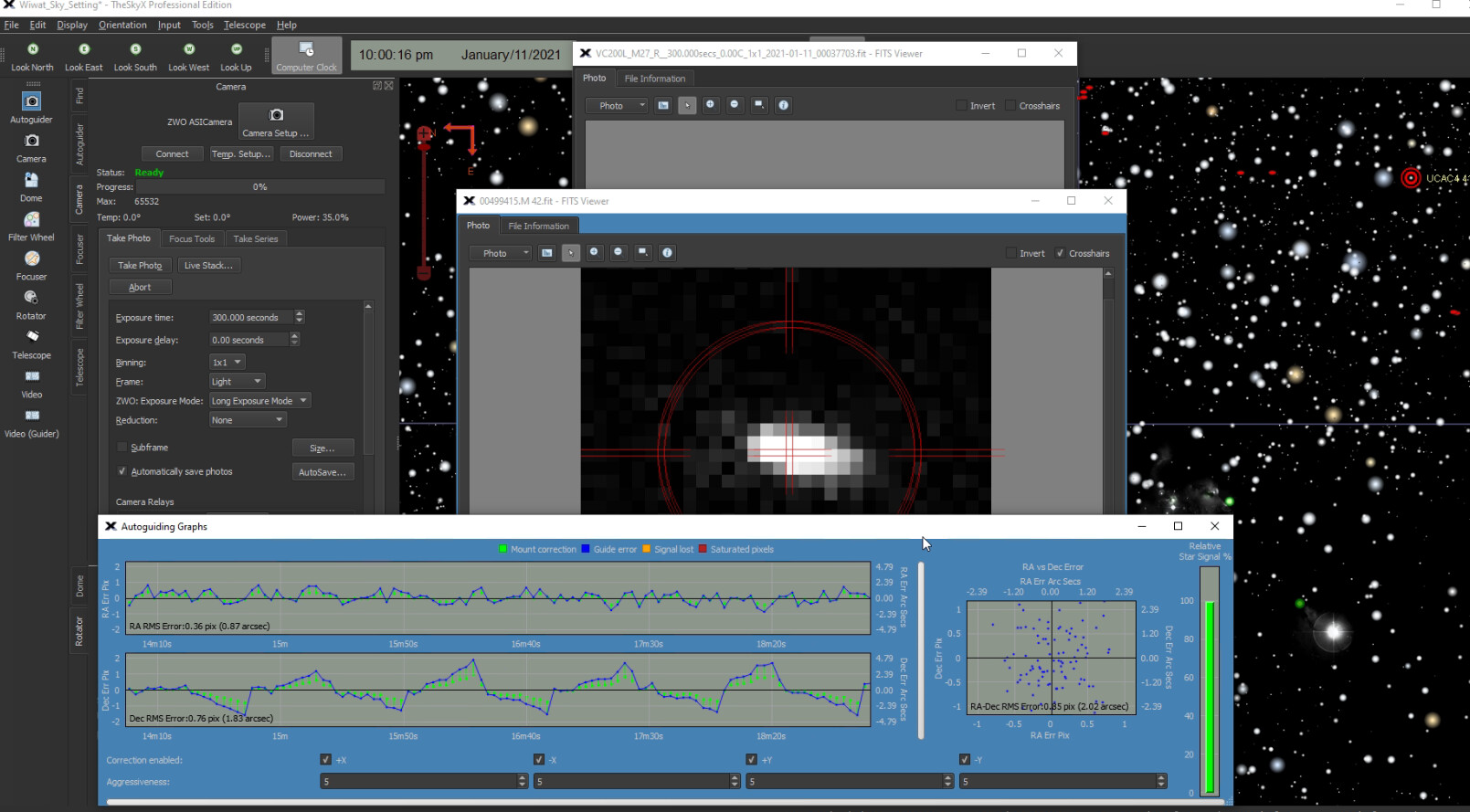
My girlfriend has a CEM25P as well and we get MUCH better guiding with it than what you show here. What telescope is mounted on the CEM25P? What guide scope and camera do you use?

Wouter

[quote=“wvreeven”]Jo,

My girlfriend has a CEM25P as well and we get MUCH better guiding with it than what you show here. What telescope is mounted on the CEM25P? What guide scope and camera do you use?

Wouter[/quote]

Hi Wouter,

Yes, I know, and the fact that this mount works so well for you was a big factor for me getting it to replace my iOptron SmartEQ mount that I had been using with the same WhiteCat 250mm and 120mm/30mm ZWO guide scope. The weight of that scope is well within the limits of the SmartEQ (11lbs) and very easily within those of the CEM25P (27 lbs).
The guide scope is not the factor in the DEC deviation. If it were, it should show the same deviation in RA, however there the guiding is nearly perfect.

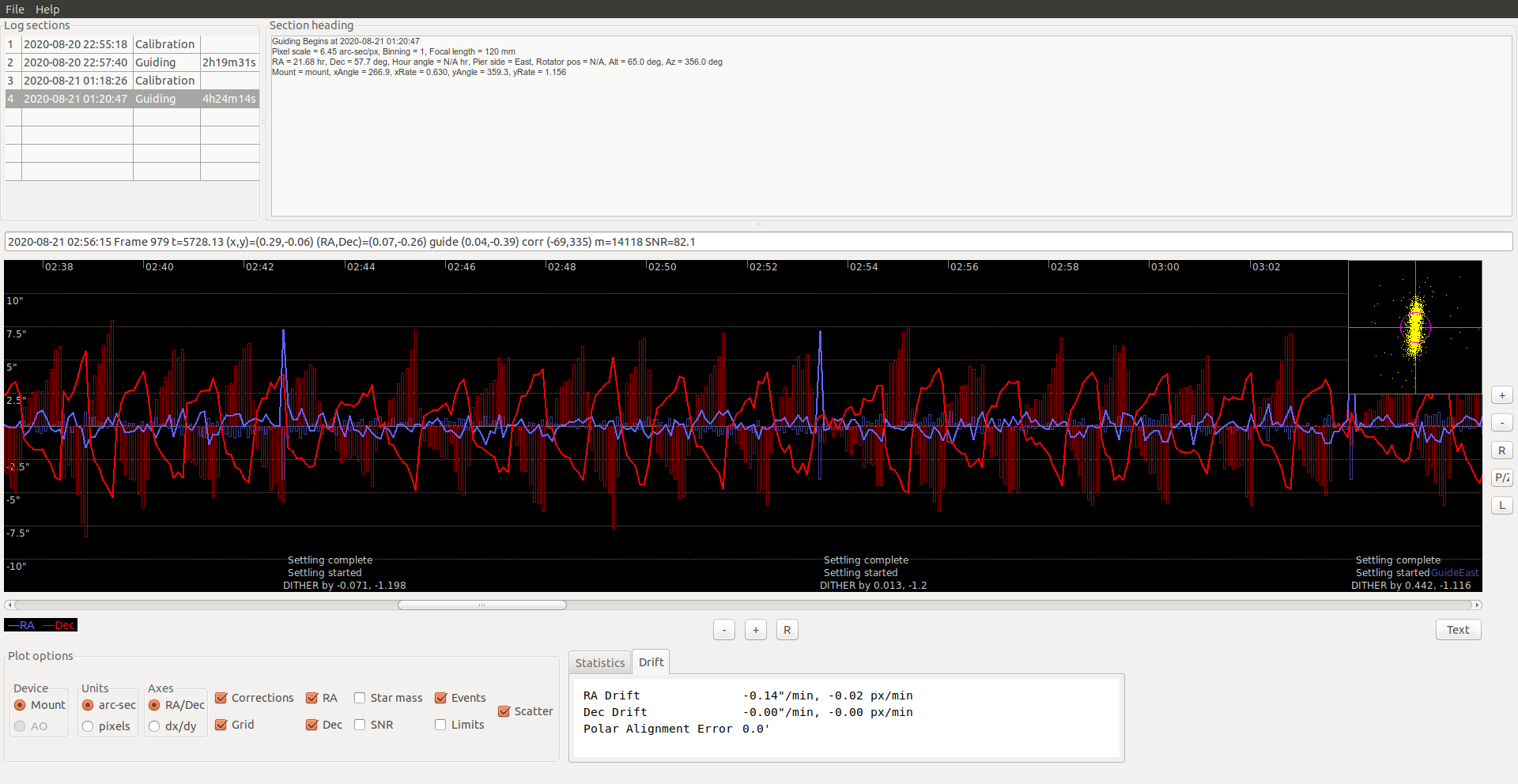
I suspect this is a mechanical problem in the DEC array only. When you look at the guide graph, these excessive deflections happen suddenly, then the guider sends repeated guide pulses to the mount that, however, have no effect whatsoever, until suddenly again, the scope swings over into the other direction. It looks to me that there is a lot of backlash, while a tension builds that, when passing a threshold, sends the mount into the opposite direction, where the same then plays out again.
I tightened the drive belt in DEC to the iOptron specifications (~3 mm play), but that had no effect at all. There is no other play I can detect when tightening the tension screw. The only thing left is the little gear wheel on the shaft of the stepper. If that is not centered and tightened, I think that could slip just enough to explain this behavior.

If anyone else has experience with that, please post here, before I tear the mount apart in vein.

Greatly appreciate any suggestions.

Jo

PS: I see the exact same behavior whether the mount is perfectly balanced or with an (intentional) slight imbalance in DEC to preload the gears and take out slack that way. Doesn’t seem to make any difference whatsoever and I would not have expected it, since there is no discernible movement when I manually try to move the mount in DEC. No mechanical play whatsoever. That’s why I think the problem is at the level of the force transfer from the stepper to the belt.

Yes that telescope should be well within specs. As a matter of fact, I ordered a RedCat for my girlfriend and she intends to use it on the CEM25P as well. Great that you get such good RA guiding with such a small focal length for the guide scope!

Could the DEC problems be related to plastic gears or shafts somewhere? Perhaps they flex when put under pressure until they cannot flex anymore and then rotate. Just a guess, I don’t know the internals of the mount well enough.

Wouter

As far as I can see, there are no plastic gears in that mount. Everything seems to be metal, which was a main reason why I wanted to switch from the plastic gear SmartEQ to the CEM25P, to avoid exactly that.
The only weak point I can see is the the belt, but that cannot be the problem as the mount is driven by exactly the same principle in RA and there is no variability. I would expect to see the same behavior then.
This must be something specific to the DEC force transfer that is causing that excessive amount of backlash.
I am still hoping to hear from someone who had the same problem and found a fix for it. If not, I’ll disassemble my - brandnew - mount and see if I can find the source of the backlash.
Not what I was planning to do…

Jo

If no solutions come then I’d advice you to contact iOptron Tech Support. They generally respond VERY quickly and adequately. But if I recall correctly, you have had the same experience in the past.

Wouter

Yes, iOptron already sent me their instructions for taking the mount apart and putting it back together to eliminate the play/slack. I am still trying to avoid making the matter more complicated than it has to be, so if anyone else has experienced that and has a suggestion what the most likely cause is, I am all ears.

I’ve found this thread on CN that might be of an interest.

I have the same issue. How did you solve the problem? Thanks.

You have to take the DEC cover off, straighten the belt and then tighten it so it has no more than 3 mm slack when you press it down in the middle. Having the proper tension and it running straight is key.
Nonetheless, this remains finicky. For instance, I can now get outstanding DEC guiding with an RMS of 0.5" early in the evening, only to see it fall apart and disintegrate to >1" after the meridian flip. That shows the mechanical limitations of the mount.
You will have to get a feel for how much tension the belt should have and whether the axle is running tight, but without excessive resistance, etc. A real problem IMO is that the DEC motor is drawing about 40% less power than the RA motor, which results in it losing steps whenever there is too much resistance.
Also, make sure that the mount is perfectly balance in DEC and that there is no cable drag. With those weak motor, you have to strive to eliminate any potential mechanical interference.
Hope that helps,
Jo

[quote=“El Corazon”]You have to take the DEC cover off, straighten the belt and then tighten it so it has no more than 3 mm slack when you press it down in the middle. Having the proper tension and it running straight is key.
Nonetheless, this remains finicky. For instance, I can now get outstanding DEC guiding with an RMS of 0.5" early in the evening, only to see it fall apart and disintegrate to >1" after the meridian flip. That shows the mechanical limitations of the mount.
You will have to get a feel for how much tension the belt should have and whether the axle is running tight, but without excessive resistance, etc. A real problem IMO is that the DEC motor is drawing about 40% less power than the RA motor, which results in it losing steps whenever there is too much resistance.
Also, make sure that the mount is perfectly balance in DEC and that there is no cable drag. With those weak motor, you have to strive to eliminate any potential mechanical interference.
Hope that helps,
Jo[/quote]

Thank you for your input. Did DEC belt tensioning eliminate the sawtooth pattern in the DEC guiding graph?

This is the DEC guiding graph I got.

For the most part. That sawtooth pattern is - I think - the result of mechanical tension that builds up as the mount fails to move in DEC until the tension breaks and is released, resulting in the overshoot in the other direction. When you adjust the tension, feel every moving part and determine whether anything snags, has resistance, etc.

Frankly, from looking at the simple construction, I am amazed that the mount can perform as well as it does (most of the time now) for me.

1 Like

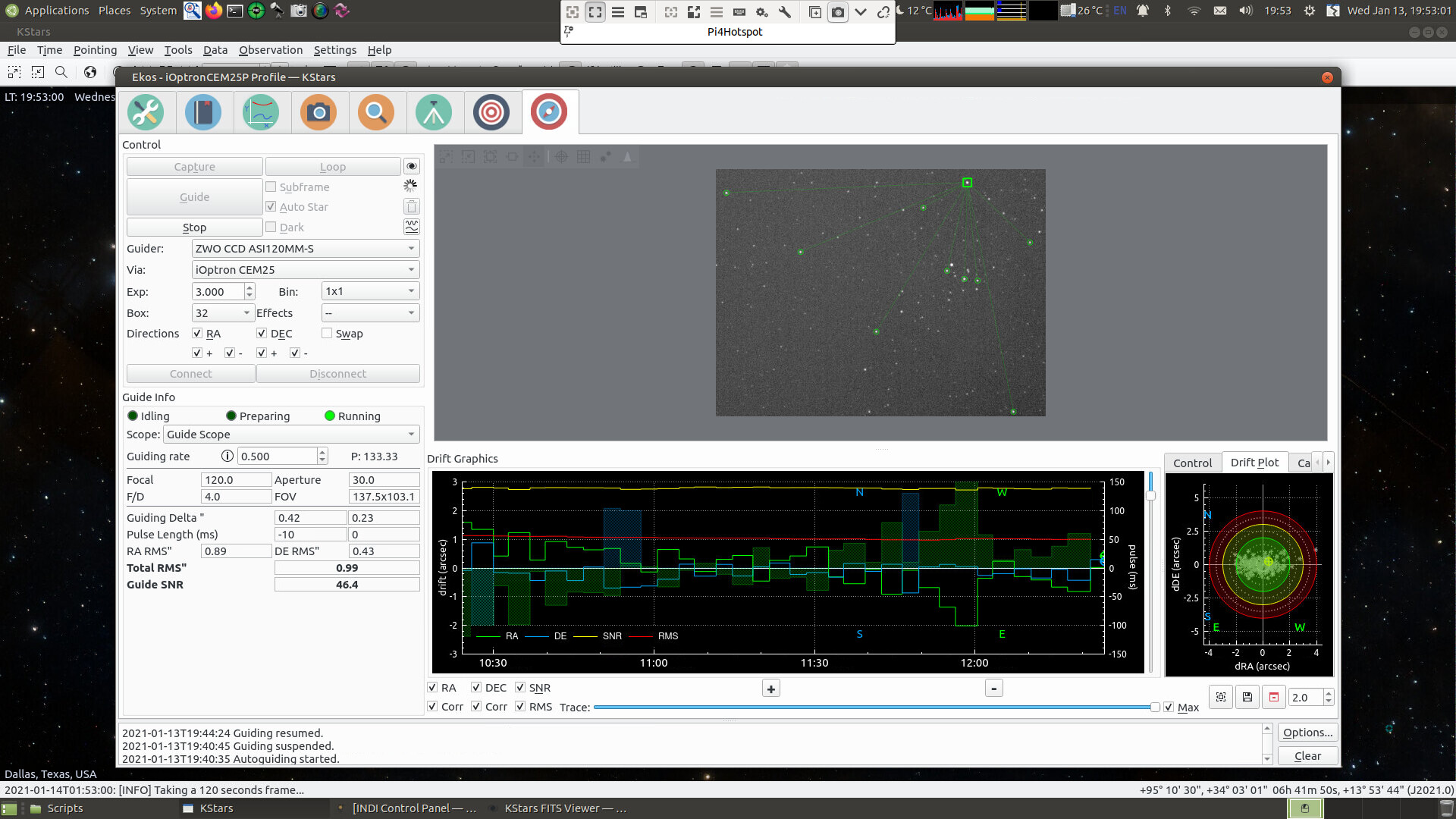
I think I got DEC pretty well under control now. Need to work on RA next:

Interesting thread - I’m trying to sort out my newish CEM25p dec behavior. Got the mount in September, but only added a guide scope in December. Never any issues with being able to move or wiggle either axis when they are locked down or with the tension knob backed out a reasonable amount - both RA and Dec are rock solid. I initially had very inconsistent guiding results - some nights quite acceptable (under 1’ total RMS), other nights (dithering every 2 images) I would get good guiding for some dithers, terrible for others. Usually good/bad behavior was predictable from the calibration. Some times Dec calibration failed, sometimes the plot was wonky (much less total movement in the Dec direction than the RA), but every once in a while it looked ‘normal’. I knew I had a backlash issue just from watching a star in the dslr live view. Speed 3 is the lowest setting where I can really tell what the mount is doing (at 10x zoom), and there was a noticeable (couple of seconds?) delay in reversing Dec direction.

Finally opened up the housing and the Dec belt was pretty slack. Tightened it - it seemed about 3mm of give. RA belt was already about like that, so I left it alone. At the same time I figured PHD2 out enough to run Guiding Assistant for the first time (so nothing to compare from before the first belt tweaking - my guess is it would have reported too much to compensate for). After the first tightening PHD2 reported 1450ms Dec backlash. It actually guided OK, but having read a CN thread where people had gotten theirs down to 3-400ms I got greedy and went back in and tightened the belt more. With very little play in the belt now, GA reported 2500ms backlash.

So - sounds like it is possible to have the belt too tight, correct?

Second question: Do we know exactly how the locking knob interacts in terms of backlash? I first backed it out enough for it to not stall at speed 9 (360 deg). At that point, it would still “hesitate” some when watching a star at speed 3, so I backed it out another 90 degrees and that was sorted. But I suspect speed 3 is still a lot faster than what the guiding pulses use, correct? So I should back it out a bit more. But is it best to just go “plenty further out” however that is defined :)? At what point does there become too little pressure to hold the worm to the gear?

Thanks for any pointers - I feel that I am close to getting good consistently guiding - I hope.

Looks like you have already gotten a good grasp of the parameters. Fine tuning them is a matter of trial and error. Also make sure you are well balanced in DEC and that you have no cable drag.
The main drawback of the DEC stepper motor is its current limit, which is about 2/3 of the RA motor (for my CEM25P). That means that the motor is prone to losing steps if there is ANY excessive drag.
As you found out, overtightening the tension screw can induce such drag.
As for sufficient pressure on the worm gear: I now wiggle the mount in DEC while tightening the tension screw. Once I can no longer feel a discernible movement, that’s when I tighten another half turn, then stop. I found that to work best in my hands. Depending on where the telescope is pointing, i.e. how much potential torque there is on DEC, I can now get the DEC RMS down to <0.5 on a good day.

All that being said, I think we have to be realistic and accept that a low end mount like the CEM25P is not optimal for telescopes with a focal length of >500 mm. I am using it with a WhiteCat (250mm focal length) and for that it is perfect.

Jo

PS: Yes, I think you can overtighten the belt. Also, make sure the belt is aligned with the gears and does not run in an oblique path over the gears.

1 Like

Finally got clear sky for an evening. Lots of moon, so I don’t even feel bad about having to spend it testing guiding. I started pointed east, within a half-hour of the meridian near the zenith. Ran GA twice and got 2490ms and 2775ms backlash. Not great, but it can probably guide OK with that.
But then I moved to the west, pointing at M45. Ran GA and got >21000ms. Tried various settings for the tension knob, but always >19000ms. So it looks like adjusting the dec mesh is my weekend project.

I think I have a decent idea what is supposed to happen. I will check the hinge tightness. But in terms of the mesh, it is basically: loosen the 3 hex screws along the hinge, lower the worm onto the ring gear. It should seat itself and in doing so move the hinge into the correct position. Then you just tighten the 3 hex screws to hold it there. I understand the part about moving the gears to find where it still binds and then re-doing the mesh there. Guess I’m just looking for confirmation that my view of how “adjusting the mesh” works is correct.

Did you watch the Paul Chasse ZEQ25 videos? I’m not sure what it is about putting a spacer between the tension screw and the hinge during the re-mesh accomplishes. My best guess is that it evens out the pressure along the hinge a bit. Did you do anything like that?

1 Like

[quote=“dx_ron”]Finally got clear sky for an evening. Lots of moon, so I don’t even feel bad about having to spend it testing guiding. I started pointed east, within a half-hour of the meridian near the zenith. Ran GA twice and got 2490ms and 2775ms backlash. Not great, but it can probably guide OK with that.
But then I moved to the west, pointing at M45. Ran GA and got >21000ms. Tried various settings for the tension knob, but always >19000ms. So it looks like adjusting the dec mesh is my weekend project.

I think I have a decent idea what is supposed to happen. I will check the hinge tightness. But in terms of the mesh, it is basically: loosen the 3 hex screws along the hinge, lower the worm onto the ring gear. It should seat itself and in doing so move the hinge into the correct position. Then you just tighten the 3 hex screws to hold it there. I understand the part about moving the gears to find where it still binds and then re-doing the mesh there. Guess I’m just looking for confirmation that my view of how “adjusting the mesh” works is correct.

Did you watch the Paul Chasse ZEQ25 videos? I’m not sure what it is about putting a spacer between the tension screw and the hinge during the re-mesh accomplishes. My best guess is that it evens out the pressure along the hinge a bit. Did you do anything like that?[/quote]

Thanks for this report! I have seen the same thing repeatedly, guiding accuracy on the same target shifting dramatically after the meridian flip. It can only be mechanical. I have not done much imaging over the last two months for personal reasons, but on the two occasions I did I thought I had that problem pretty much gotten down to a minimum.

I did not know about the ZEQ25 videos. Can you post the link?

Best, Jo

Sure: ZEQ25 Tune Part 1 That should link you directly to parts 2 and 3, let me know if it doesn’t.

I don’t think Paul is currently active on CN (astronewb), or I’d ask him why he says the metal ruler is the secret weapon in getting the perfect mesh. I guess the same principles apply to the CEM25P and ZEQ25. The upgrade kit included a new motor and a new worm gear, but not anything different with the hinge and worm housing.

A few nights in a row of clear skies! (starting last night)

I did open and adjust the dec mesh. I started, per the instructions, by adjusting the hinge tightness It was very stiff - better than having play, but might as well get it to what it supposed to be correct. I did not notice until completing that adjustment that the motor bracket was physically blocking access to one of the 3 mesh-adjustment hex screws. So I had to loosen one hinge screw quite a lot and use the two sides together to move the bracket enough to get access to the screw, then readjust the tightness.

Remeshed a few times, rotating the worm by hand to see if I ran into a tight spot, then remesh again there. I probably could have kept that up longer and maybe found an even higher spot on the axis gear, but I think it’s probably pretty good now.

I was anxious to prove to myself that I could put it all back together without any leftover parts and have it still work, so I did not notice until it was all back in that the hinge was back to being very stiff again. I really did not want to remove the motor and plastic shield again (I mean I could, but I thought up a lazier way to do it). I popped on Amazon and ordered a set of low-profile hex wrenches. That let me gain access to the locking screw with the plastic cover and motor still in place. The 4mm wrench was not quite stubby enough to engage the main screw itself, but the long ends have a ball that allow at least some engagement from an angle. I knew I didn’t need to turn the screw, I just needed a tiny bit of nudge in the right direction. Success followed, so the hinge now moves easily but does not flop around on its own, and there is still no side-to-side play.

Spent a bunch of time last night running Guiding Assistant, varying how much I loosened the tension knob. About half way through I finally got smart and used a sharpie to mark the knob so I actually know how far I have rotated it. So I started again.

Basically, it is now ‘OK’ - far better than the >25000ms before remeshing.

(question for you El Corazon: when you say ‘half turn’ do you mean 180 degrees? Sounds like a silly question, but lots of people call 180 degrees ‘one turn’ when referring to the tensioner knobs, because it is way more practical to turn them 180 degrees at a time. Below, when I say 1 turn, I mean 360 degrees)

1.125 turn out from fully tightened: 3100ms
1.25 out: 3100ms
1.5 out: 2200ms
1.75 out: 1760ms
2 out: 1650ms
2.25 out: 1350ms
2.5 out: 1300ms

The knob itself was starting to feel quite loose by 2.5 turns out, so I stopped there and just let it guide while taking some pictures. Guiding settled in at 0.65" - 0.7" total RMS and always recovered after dithering. Then I learned what time M42 starts to pass behind a tree :slight_smile:

I’ll go back out tonight and concentrate more on just capturing and following guiding performance, hopefully with some time on both sides of the meridian.