I did the RA re-mesh today. I’ve learned a few things along the way that I might write up for a post over at CN, though there won’t be any more new factory-fresh CEM25P owners,As for the RA box, the hinge was very, very tight. So much so that I doubt the spring was having any effect on the gear tension at all, Getting the hinge so it moves easily made it so much easier to simply lock down the RA worm correctly - up til now I always had to be very careful to avoid having the worm land more on top of gear teeth. I can’t swear that is what qas happening, but that’s what it felt like, and the tension bolt obviously would not seat all the way down against the plastic housing. When it landed like that, there’d be a degree or two of play in the RA axis, so I’d unlock and start over. Now the RA worm just drops right down and there is no play even wheh the tension bolt is still only halfway in.First couple of nights of testing has me optimistic that I’ve got this dialed in reasonably well.
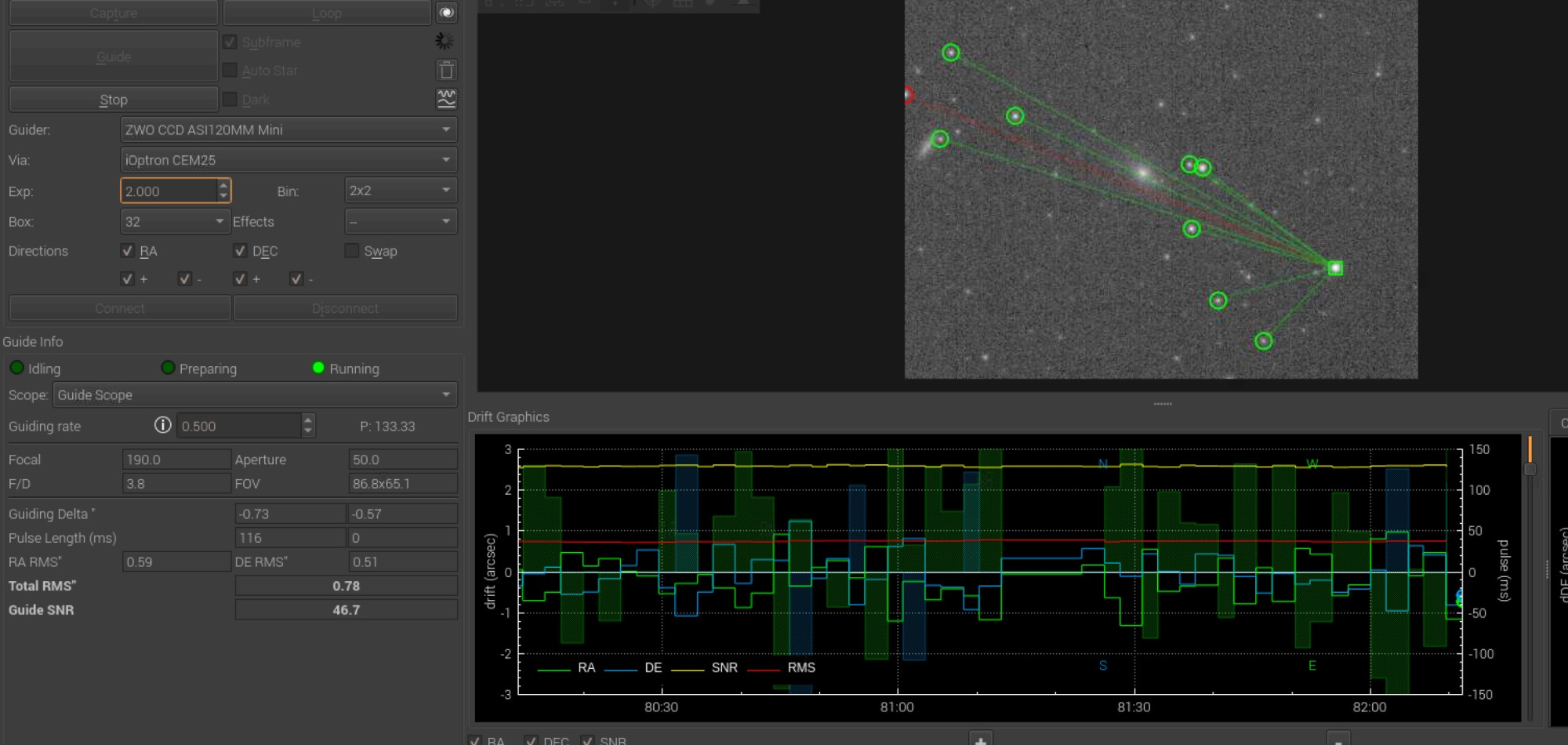
[EDIT] - posted a screenshot yesterday of really excellent guiding results that turn out to have been bogus. I had switched from 1x1 to 2x2 binning during my session and apparently Ekos does not understand the new guider image scale.Last night I guided at 1x1 for an hour, then stopped, cleared the calibration, set 2x2 binning, recalibrated, then went back to the same target and guided again. Doing this, guiding results from 2x2 were basically the same as 1x1. still decent enough that I’m happy I went through the tuning process. In particular, I have not seen RA stiction - previously I would often run several consecutive guide exposures with RA corrections being issued but no response. See the next post for real results.
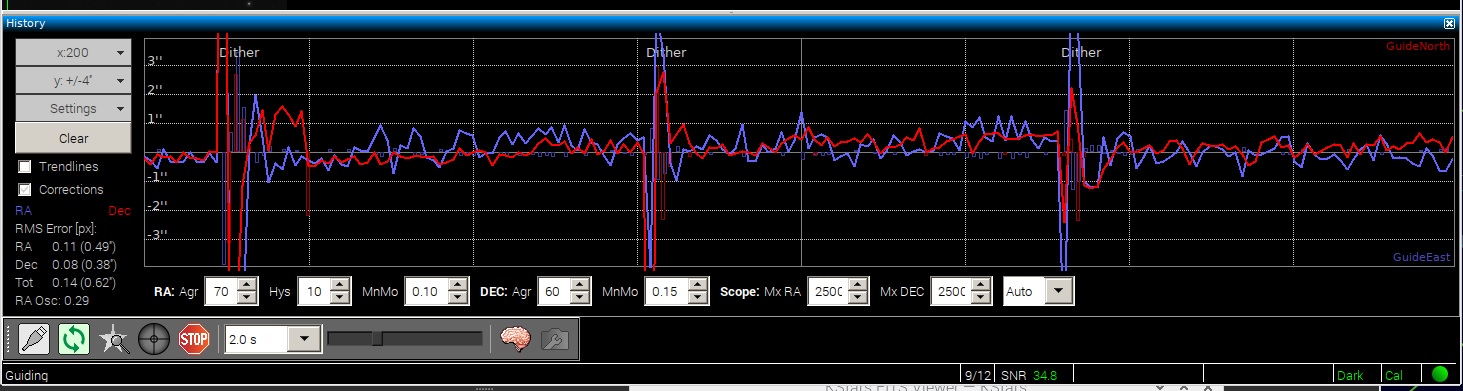
Here is typical (real) guiding results post-tuning. I’m not sure if I will keep playing with the dec or not. According the PHD2 I have ~1700ms dec backlash.
In favor of more playing: it would be nice to have lower backlash, and now at least I am quite comfortable taking it apart and putting it back together.
In favor of leaving well enough alone: the guider seems to deal well with the backlash anyway; it’s not so easy to do, as one must make some change, then wait for the next clear night to find out if you made it better (or worse!), and then wait until the next day to tweak again, and there’s no easy way to measure how much tension you’ve put on the belt (and no, I am not brave/foolish enough to unmount the OTA and open up the dec housing outside at night! - though maybe just for the simplest thing of changing the belt tension - hmmm)
I did keep playing with the belt tension some more.
Doing that, I learned a thing: the mounting holes in the stepper motor strip easily
So I learned another thing: the stepper motor can be partly disassembled and the front end cap rotated to avoid the stripped hole (thanks to some iOptron user groups folks on fb)
And a final thing I have learned: the dec backlash reported by PHD2 Guide Assistant does not correlate much with the backlash adjustment value after guiding a while. For example, last night I received a backlash measurement of 2800ms from GA, and let PHD2 set that as the value. Even though that seems like an abysmal number, it guided really well:
that is about an hour into the session, but is typical for both last night and the last few nights (hope I’m not jinxing myself!). When I opened “Advanced Settings”, the dec backlash adjustment had settled in at about 750ms, which is way better than any value I have ever gotten from the Guide Assistant measurement.
I never checked the backlash value in PHD2. I only look at the scatter plot in the Guide module and if that looks good, I am happy, too.
As long as the stars are round and small, things are going well in my book.
Jo